
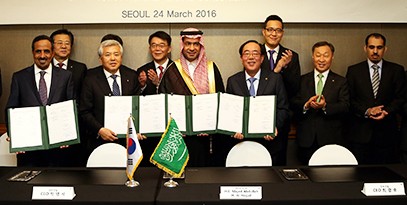
His Excellency the Minister of Housing, Mr. Majid bin Abdullah Al-Hogail, today signed a Memorandum of Understanding (MoU) in Seoul, the capital of the Republic of Korea, between the Saudi Ministry of Housing and the Korean Ministry of Land, Infrastructure and Transport.
The MoU was signed in accordance with the approval issued by the Council of Ministers pursuant to Royal Decree No. (24121) dated 16/5/1437 AH, in implementation of the directives of the Custodian of the Two Holy Mosques, King Salman bin Abdulaziz Al Saud, His Royal Highness the Crown Prince, and His Royal Highness the Deputy Crown Prince—may God protect them—to accelerate housing solutions by leveraging international expertise. The agreement also aims to support the Ministry of Housing with financial mechanisms that enable it to become more self-sustaining and reduce reliance on direct government funding.
The Korean housing model has attracted significant attention from observers of the housing sector due to its practical solutions that encourage private-sector participation and attract diversified investment, allowing government entities to focus on legislation and regulation. The MoU covers all aspects of the housing industry, most notably the exchange of expertise in rapid construction methods that enable the delivery of attractive housing products in record time, as well as mechanisms to stimulate investment in the housing sector. It also includes the organization of joint workshops, exchange visits between specialists, and the hosting of conferences and seminars to support a qualitative leap in housing solutions for Saudi citizens.
One of the first outcomes of this cooperation was the signing of an additional MoU between the Saudi Ministry of Housing and a Saudi–Korean consortium to develop 100,000 housing units over the next ten years in northern Riyadh. The consortium consists of three companies: Daewoo Engineering & Construction and Hanwha Corporation from Korea, and SAPAC (Pan Kingdom Saudi Company) from Saudi Arabia.
Daewoo Engineering & Construction, a global company established more than forty years ago, operates in over 30 countries and possesses extensive expertise in project management and the development of residential suburbs and small cities. It has delivered major housing solutions in countries including Malaysia and Libya and has been ranked first in housing development for seven consecutive years.
Hanwha Corporation, founded more than sixty years ago, specializes in both vertical and horizontal housing development and operates more than 100 branches worldwide. The company is known for its rapid construction technologies and was recently selected to build 100,000 housing units in Iraq.
SAPAC (Pan Kingdom Saudi Company), the Saudi partner in the consortium, was established more than 25 years ago and is classified at the highest level in multiple sectors. The company specializes in infrastructure development, including the construction of roads, bridges, hospitals, hotels, and residential and commercial complexes. SAPAC employs more than 10,000 people and owns both a steel plant and a cement factory in the Northern Borders Region.
The Saudi–Korean alliance will undertake full responsibility for financing, development, marketing, construction, operation, and maintenance, aiming to deliver a model of sustainable and self-sufficient urban development. In addition to the 100,000 housing units, the project will include major commercial complexes, parks, green spaces, government facilities, and integrated commercial services. The Ministry of Housing intends for this project to serve as a benchmark for future housing developments under its supervision.
These memoranda of understanding reflect the strength of the Saudi economy and the confidence of international companies in the Kingdom, particularly in the real estate sector, with global firms committing direct investment to project implementation. During the visit, His Excellency the Minister of Housing and his accompanying delegation reviewed successful Korean housing experiences and toured several projects developed by the two Korean companies, receiving detailed briefings from His Excellency the Korean Minister on these models and practices.